
Choosing between an oil-free vacuum pump and an oil-sealed pump is one of the first decisions anyone sourcing vacuum equipment has to make.
The price gap can be significant. The application fit can be even more significant. Buying the wrong pump to save money upfront can cost far more in maintenance, downtime, and contamination losses. This guide breaks down the core differences so you can make a confident decision before committing to a purchase.
How Each Pump Works — The Difference Is Bigger Than It Looks
1.1 How Oil-Sealed Vacuum Pumps Work
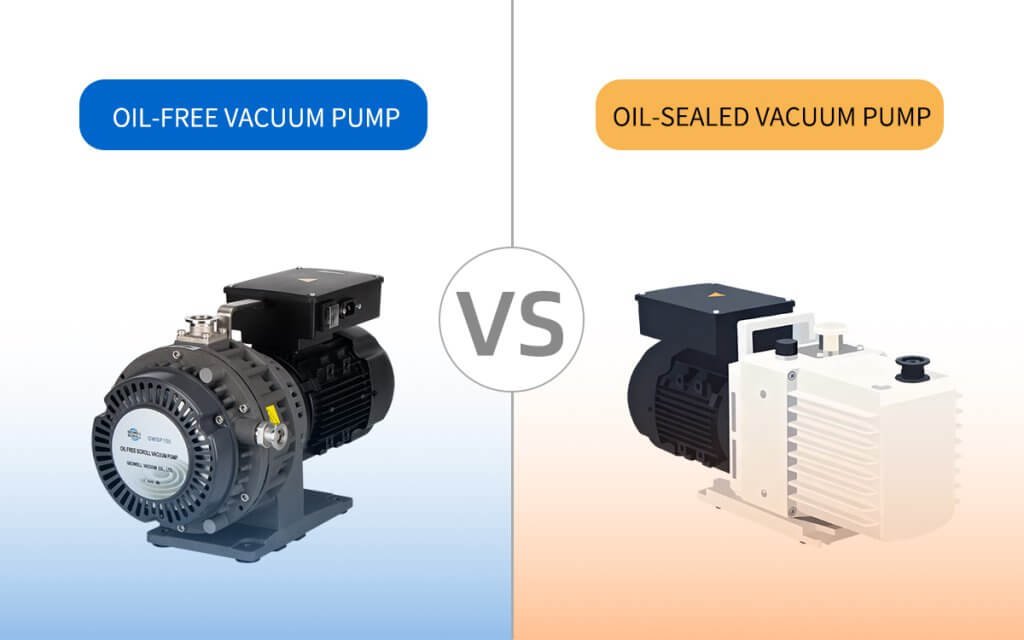
Oil-sealed vacuum pumps — rotary vane pumps being the most common type — rely on lubricating oil inside the pump chamber to seal clearances and carry away heat. Vanes rotate on an eccentric rotor, continuously compressing gas and exhausting it.
Oil is essential to this mechanism. Without it, the sealing effect breaks down and vacuum level deteriorates. This also means that during normal operation, oil vapor inevitably mixes into the gas being pumped.
For general industrial use, this is often acceptable. But if the downstream application is a mass spectrometer, an electron-beam deposition chamber, or a cell culture environment — that trace oil contamination is enough to ruin an experiment or a production run.
1.2 How Oil-Free Vacuum Pumps Work
An oil-free vacuum pump comes in several types — dry screw, claw, scroll — but the shared principle is that no lubricating oil is involved in the sealing action inside the pump chamber.
According to SEMI, semiconductor manufacturing cleanliness requirements have tightened significantly at advanced process nodes. Take the oil-free scroll vacuum pump as an example. It uses the relative motion of a fixed scroll plate and an orbiting scroll plate — both precision-machined — to compress gas. The orbiting scroll moves in a planar orbital path, drawing gas in from the outer edge and compressing it toward the center before discharge. The entire process is clean, smooth, and oil-free.
This design makes scroll pumps inherently suited to applications where process gas purity matters. No oil circuit means simpler internal architecture, fewer failure points, and maintenance that does not require handling hazardous fluids.
2. Performance Parameters: Ultimate Pressure, Pumping Speed, and Stability
2.1 Ultimate Pressure
Oil-sealed rotary vane pumps (single-stage) typically achieve ultimate pressures in the 1–5 Pa range. Oil-free scroll vacuum pumps generally achieve 0.7–5 Pa — fully sufficient for the majority of medium-to-high vacuum applications.
If your process requires pressures below 10⁻⁴ Pa, both pump types need to be paired with a turbomolecular pump. In mid-range vacuum applications, ultimate pressure is rarely the deciding factor between these two types.
2.2 Pumping Speed
Pumping speed (expressed in L/s or m³/h) measures how much gas the pump can move per unit time. Both categories offer a range of sizes for different chamber volumes and process cycle times.
One practical advantage of oil-free scroll pumps: their pumping speed curve tends to stay flatter in the low-pressure region. Some oil-sealed pumps show a steep drop-off in pumping speed as they approach ultimate pressure. For processes that need to hold a stable low pressure, this matters.
2.3 Operational Stability and Noise
Oil-free scroll pumps produce lower vibration and noise than oil-sealed rotary vane pumps of equivalent power — there is no high-speed vane friction. This is particularly relevant in laboratory environments and near vibration-sensitive instruments.
Oil-sealed pumps tend to get louder as the oil ages or oil level drops. This is often a signal that maintenance is overdue. Oil-free scroll pumps are monitored by checking seal condition on a schedule, not by listening for abnormal sounds.
3. Lifecycle Cost: Running the Numbers
3.1 What Routine Maintenance Actually Involves
When comparing an oil-free vacuum pump against an oil-sealed alternative, maintenance cost is one of the most important factors. Oil-sealed rotary vane pump maintenance typically includes: periodic oil changes (frequency varies from a few hundred to a few thousand hours depending on application), oil mist filter replacement, exhaust valve inspection, and pump chamber cleaning. Waste oil disposal and accumulated downtime are real costs.
For oil-free scroll vacuum pumps, the primary maintenance item is tip seal replacement — the scroll-plate end seal that is central to pump performance. Replacement interval is typically 8,000 to 16,000 hours, depending on operating conditions and gas cleanliness.
3.2 Total Cost of Ownership
On purchase price alone, oil-sealed rotary vane pumps are usually less expensive. But when oil consumption, waste oil disposal fees, labor, and downtime are included, the long-term cost gap is often much smaller than the initial price difference suggests.
For 24/7 continuous operation, tip seal replacement on a scroll pump can be completed quickly with minimal downtime. Oil changes on rotary vane pumps accumulate into significant time costs over the equipment’s lifetime.
There is also a less visible cost category: product loss or experiment failure caused by oil contamination. In semiconductor fabrication or biopharmaceutical research, a single oil contamination incident can cost far more than the pump itself.
4. Application Fit: Where Oil-Free Is the Right Answer
4.1 Applications Where Oil-Sealed Pumps Carry Unacceptable Risk
An oil-free vacuum pump eliminates contamination at the source. Some processes have essentially zero tolerance for oil contamination:
- Semiconductor lithography, thin-film deposition, and ion implantation — oil vapor on wafer surfaces causes yield loss
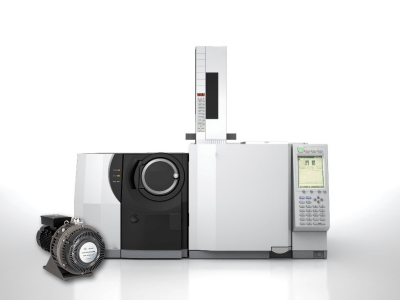
- Mass spectrometers and gas chromatographs — oil contamination affects measurement accuracy and can damage ion sources
- Biosafety cabinets, cell culture equipment, and gene sequencing instruments — clean vacuum is a prerequisite for experimental reproducibility
- Pharmaceutical and food vacuum packaging and freeze-drying — process gas in direct contact with product cannot contain oil
- Fuel cell and new energy research equipment — trace oil contamination affects catalyst activity and data integrity
4.2 Where Oil-Sealed Pumps Are Still a Reasonable Choice
Oil-sealed rotary vane pumps are not obsolete. In certain contexts they remain a sensible option:
- General industrial vacuum applications where process gas cleanliness is not a requirement
- Budget-constrained non-precision applications where upfront cost is the primary constraint
- Applications requiring very low ultimate pressure (dual-stage, below 0.1 Pa) where an oil mist separator is acceptable
The key is being clear about how sensitive your process is to oil contamination, and what your actual long-term maintenance resources look like.
5. Technical Advantages of Oil-Free Scroll Vacuum Pumps
— In Practice
5.1 Simpler Design, Lower Maintenance Threshold
Oil-free scroll pumps have a more straightforward internal architecture than dry screw or claw pumps. Fewer moving parts, no synchronization gears, no oil circuit — this directly reduces the number of potential failure points.
For laboratories or small-to-mid-size businesses without a dedicated maintenance team, operators can handle routine servicing themselves without requiring a field engineer for every scheduled maintenance.
5.2 Air Flush Function for Moisture-Containing Gas
Many vacuum applications involve pumping gas that contains water vapor or other condensable gases. Oil-free scroll vacuum pumps typically include an air flush valve that introduces a small amount of dry air at the exhaust side, preventing water vapor from condensing inside the pump and protecting seals and pump body.
Using a scroll pump with air flush to handle humid gas carries significantly less risk than an oil-sealed pump — where oil emulsification turns an oil change into an emergency task.
5.3 Environmental Compliance — Increasingly Important
Waste oil disposal is subject to strict environmental regulations in many countries. Using an oil-free vacuum pump eliminates waste oil generation entirely, reducing both compliance cost and environmental liability.
For companies pursuing ESG targets or green manufacturing certification, eliminating oil from the equipment side is a concrete and verifiable contribution.
5.4 Flexible Start/Stop for Non-Continuous Processes
Oil-free scroll pumps can be started and stopped frequently between atmospheric pressure and vacuum without the cold-start lubrication concerns that affect some oil-sealed pump designs. For laboratories or batch production lines that cycle the pump regularly, this is a practical advantage.
6. Before You Decide: Questions Worth Asking
These questions help narrow down the selection quickly:
- Is the gas being pumped, or the downstream process, sensitive to oil contamination? If yes, oil-sealed pumps are off the table.
- Does the equipment need to run 24 hours a day? Compare maintenance frequency and downtime duration for both types.
- Is this for a laboratory or clean-environment application? Environmental conditions affect pump cooling and seal lifespan.
- Is the budget based on purchase price or total lifecycle cost? Long-term, the gap may be smaller than it initially appears.
- Are there industry standards or certifications that require oil-free vacuum equipment?
- Is there infrastructure on-site for waste oil disposal? If not, oil-free eliminates that requirement entirely.
Working through these questions narrows the field significantly. For anything still unclear, discussing specific process conditions with a supplier who has hands-on application experience is more useful than comparing spec sheets alone.
7. Quick-Reference Comparison Table
The table below summarizes the most commonly referenced parameters for vacuum pump selection decisions.
| Parameter | Oil-Free Scroll Vacuum Pump | Oil-Sealed Rotary Vane Pump |
| Working principle | Scroll-plate mechanical compression, fully oil-free | Vane + lubricating oil sealed compression |
| Ultimate pressure | Down to 1 Pa range (select models ≤0.7 Pa) | Single-stage 1–5 Pa; dual-stage below 0.1 Pa |
| Oil contamination risk | None — clean gas path throughout | Oil vapor back-streaming risk present |
| Routine maintenance | Replace tip seal ~every 8,000–16,000 hours | Oil changes every few hundred to thousands of hours + filter element |
| Noise / vibration | Low (no vane friction) | Relatively higher; increases as oil degrades |
| Initial purchase cost | Mid-to-high | Low |
| Lifecycle cost | Low (low maintenance frequency, no waste oil cost) | Mid-to-high (oil, waste disposal, labor) |
| Environmental compliance | No waste oil — low regulatory burden | Waste oil disposal subject to regulations |
| Typical applications | Semiconductor, analytical instruments, biopharma, food & pharma | General industrial vacuum, non-precision processes |
8. About Geowell Vacuum
Geowell has been developing and manufacturing oil-free vacuum pumps — specifically oil-free scroll vacuum pumps — since 2002, over 20 years focused on one product category. The company holds more than 100 patents and proprietary technologies, carries CE, RoHS, EAC, and ISO 9001 certifications, and has products in use across 60+ countries and regions with more than 100,000 users worldwide.
The GWSP, GWSPB, and GWSPS series oil-free scroll vacuum pumps are deployed in semiconductor equipment, analytical instruments, biopharmaceutical research, materials science, food and pharmaceutical processing, and vacuum system integration.
If you are working through a pump selection for a specific application, Geowell’s technical team is available to review your process parameters and provide targeted recommendations.
Contact Geowell: +86-24-83685362 | service@geowellscroll.com | www.geowellscroll.com
9. Frequently Asked Questions
Q: What is the most fundamental difference between oil-free and oil-sealed vacuum pumps?
A: The most fundamental difference is whether lubricating oil is involved in the sealing action inside the pump chamber. Oil-sealed pumps rely on oil for sealing and lubrication, and produce oil vapor during operation. Oil-free pumps achieve sealing through mechanical geometry — scroll plates, screws, or similar — and produce no oil contamination in the pumped gas.
Q: Does an oil-free vacuum pump have worse ultimate pressure than an oil-sealed pump?
A: Not necessarily. Oil-free scroll vacuum pumps typically achieve 0.7–5 Pa, which covers the majority of medium-to-high vacuum applications. Oil-sealed dual-stage rotary vane pumps can reach below 0.1 Pa, but at those vacuum levels, additional equipment is usually involved regardless. Comparing ultimate pressure alone between the two types has limited practical relevance for most applications.
Q: Is the maintenance cost of an oil-free vacuum pump actually lower?
A: Over the long term, typically yes. The primary maintenance for an oil-free scroll pump is tip seal replacement, approximately every 8,000–16,000 hours. Oil-sealed pumps require more frequent oil changes, filter replacement, and waste oil disposal. When all costs — including downtime — are included, the total maintenance cost of oil-sealed pumps is generally higher.
Q: Should a laboratory vacuum pump be oil-free or oil-sealed?
A: For laboratory use, oil-free vacuum pumps are strongly preferred — especially in analytical instrument applications, biological research, or any context requiring a clean vacuum environment. Oil vapor back-streaming from oil-sealed pumps can compromise experimental reproducibility and damage sensitive equipment.
Q: Can oil-free scroll vacuum pumps handle gas containing water vapor?
A: Yes, with the air flush valve open. The air flush function introduces a small amount of dry air at the exhaust side, preventing water vapor from condensing inside the pump and protecting seals and internal components. Most oil-free scroll vacuum pumps include this feature as standard.