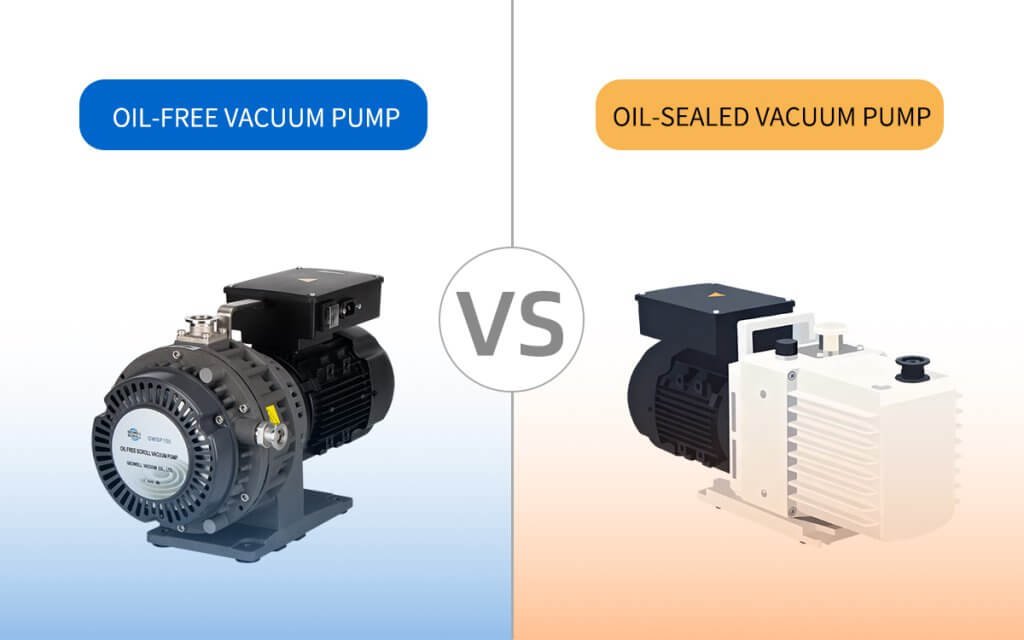
Before diving into selection, it helps to correct a common misconception: “oil-free vacuum pump” — also called a dry vacuum pump — is not a single pump model, it is a category. The defining criterion is simple: no lubricating oil contacts the gas pathway inside the pump chamber. How that is achieved, however, varies dramatically across different pump architectures.
In the rough-to-medium vacuum range, three types dominate the market: scroll, claw, and diaphragm. For deeper vacuum levels, molecular drag pumps are typically added to the system. This guide covers all four types in a single comparison, spanning the full range from benchtop laboratory setups to ultra-high vacuum systems.
Choosing the wrong pump type can mean failing to meet process targets — or worse, compromising equipment safety and product quality. This guide provides a structured comparison and a clear 3-step selection framework to help purchasing managers and process engineers make confident decisions.
For a deep dive into scroll pump mechanics, see our companion article: How Does an Oil-Free Scroll Vacuum Pump Work?
1. Why Are There So Many Types of Oil-Free Vacuum Pumps?
To understand the landscape, start with what oil actually does inside a conventional oil-sealed pump. In a rotary vane pump, lubricating oil serves three simultaneous functions:
- Sealing — oil fills micro-gaps between moving parts, creating the airtight compression chamber
- Lubrication — oil reduces friction and wear between contacting surfaces
- Cooling — oil absorbs and dissipates heat generated by compression
Remove the oil, and all three functions must be addressed by other means. Each oil-free architecture takes a different engineering approach:
- Sealing without oil: precision-machined scroll geometry (scroll pumps), synchronized non-contact rotors (claw pumps), or full physical separation via a flexible membrane (diaphragm pumps)
- Lubrication: bearings and drive components are lubricated outside the gas pathway; the gas channel itself needs no lubrication
- Cooling: handled by fan-cooled housings and thermally conductive materials
Key Insight: The differences between oil-free pump types reflect different engineering trade-offs in replacing oil — not differences in quality or capability. Understanding this is the foundation of sound selection logic.
2. The Four Main Types: Detailed Breakdown
2.1 Oil-Free Scroll Vacuum Pump
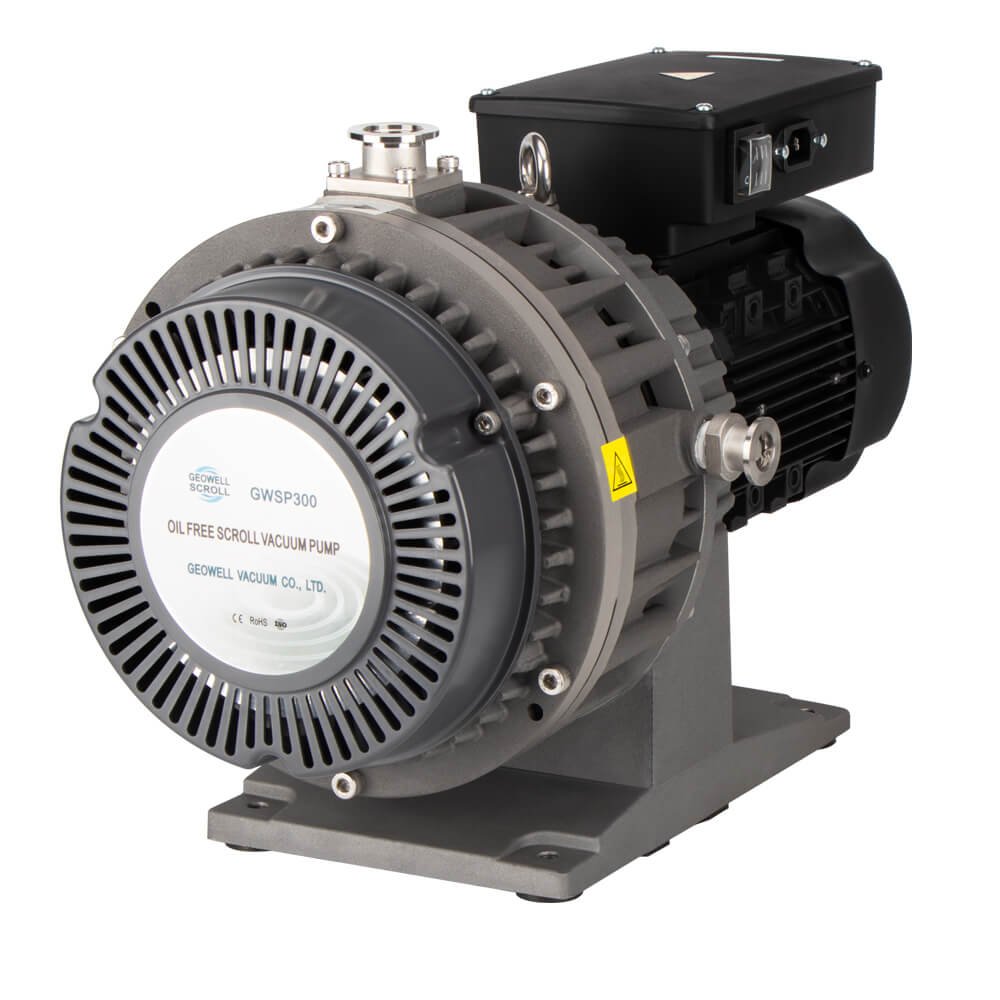
The scroll type offers the most balanced overall performance profile in the oil-free pump market, covering the widest range of applications. It is Geowell’s core product line.
Working Principle: The pump head consists of a fixed scroll and an orbiting scroll — two spiral-shaped discs with interlocking vane walls. As the orbiting scroll traces a small circular orbit, the interlocked spiral walls form crescent-shaped sealed chambers that progressively move inward, compressing and discharging gas. Sealing is achieved entirely through precision-machined tip seals and tight tolerances — no oil involved.
Core characteristics:
- Ultimate vacuum: down to 0.7 Pa (Geowell GWSPB series) — among the best in oil-free rough/medium vacuum
- Low noise: no reciprocating impact; typical noise level approximately ≤50 dB(A) (model-dependent)
- Low maintenance: only tip seals and O-rings require periodic replacement; service interval ≥16,000 hours
- Clean gas pathway: zero hydrocarbon contamination — suitable for the most stringent purity requirements
- Flexible operation: supports frequent start/stop cycles with no warm-up required
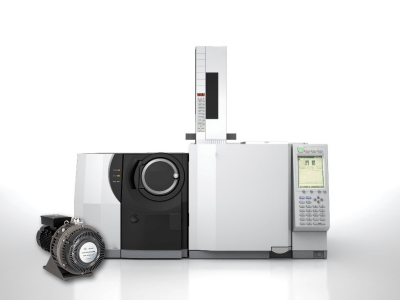
Best suited for: laboratory instruments, analytical instruments (mass spectrometers, GC-MS, LC-MS), semiconductor fabrication, biopharmaceutical manufacturing, precision industrial processes.
2.2 Claw Vacuum Pump
The claw type delivers the highest pumping speeds among compact oil-free designs, making it the preferred choice for high-throughput industrial applications.
Working Principle: Two claw-shaped rotors counter-rotate inside the pump chamber, synchronized by precision timing gears. The rotors maintain a very small, non-contact clearance. As they rotate, the claw geometry creates expanding and contracting chambers that draw in and discharge gas. The non-contact operation is maintained purely by the timing gears — no oil enters the gas stream.
Core characteristics:
- High pumping speed: capable of very high volumetric flow rates — ideal for rapidly evacuating large chambers
- Multi-stage capability: multi-stage claw configurations can reach the low Pa range (specific performance depends on design)
- Compact footprint: achieves high throughput in a relatively compact package
- Moderate maintenance: timing gears require periodic inspection; more complex than scroll pumps
- Moderate noise: aerodynamic noise from high-speed rotors is somewhat higher than scroll pumps
Best suited for: industrial large-volume evacuation, chemical process gas recovery, applications requiring very high pumping throughput.
2.3 Diaphragm Vacuum Pump
The diaphragm type is the simplest and most accessible oil-free pump, widely used for small-scale laboratory support tasks.
Working Principle: A flexible diaphragm is driven back and forth by a crank-and-rod mechanism. Downward deflection expands the chamber, drawing gas in through the inlet valve; upward deflection compresses and expels the gas through the outlet valve. The diaphragm physically separates the drive mechanism from the gas stream — the gas pathway is inherently oil-free.
Core characteristics:
- Simple construction: fewer parts, lower manufacturing cost, affordable purchase price
- Easy maintenance: the diaphragm is the main consumable and is straightforward to replace
- Chemical resistance: specialized diaphragm materials (e.g. PTFE) allow handling of corrosive gases
- Limited ultimate vacuum: typically in the range of tens to hundreds of Pa — not comparable to scroll or claw pumps
- Limited flow rate: suitable for small volumes only; not appropriate for large-chamber evacuation
Best suited for: small lab support equipment (rotary evaporators, solid-phase extraction), corrosive gas applications with specialized diaphragm materials, budget-sensitive setups where high vacuum is not required.
2.4 Molecular Drag Pump
The molecular drag pump operates in a pressure regime where the other three types cannot function effectively — the ultra-high vacuum range.
Working Principle: A rotor spinning at extremely high speed imparts momentum to gas molecules through a drag effect, transferring them from the low-pressure inlet side to the high-pressure outlet side. Because the mechanism relies on momentum transfer rather than volume displacement, it only operates efficiently at very low pressures in the molecular flow regime (below ~1 Pa).
Core characteristics:
- Ultra-deep vacuum: operates in the molecular flow regime (<1 Pa) as part of a compound pumping system
- Very high rotational speed: tens of thousands of RPM, requiring precision engineering
- Complex and costly: high reliability demands, demanding maintenance requirements
- Requires a backing pump: serves as the primary pumping stage in a UHV system alongside a backing pump (e.g. oil-free scroll pump) — cannot establish vacuum independently
Best suited for: ultra-high vacuum research equipment, electron beam / ion beam instruments, particle accelerators, and applications requiring pressures below 10⁻³ Pa.
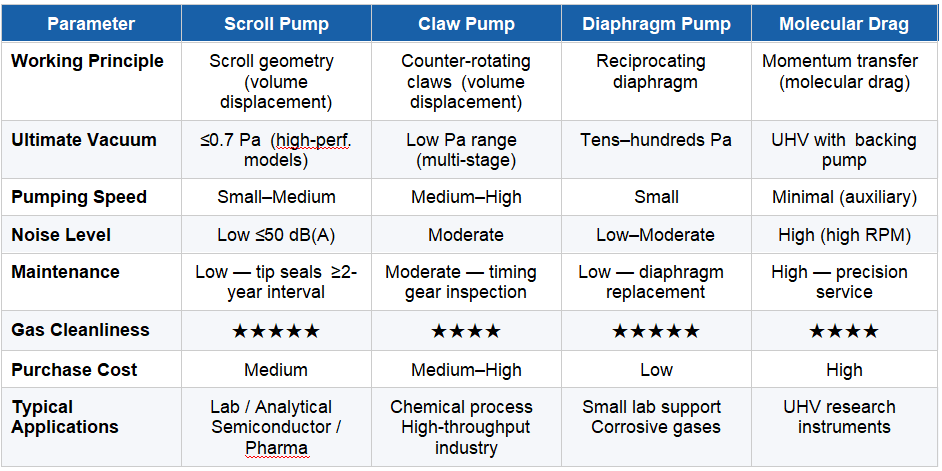
3. Side-by-Side Comparison: All Four Types
4. Five Key Application Scenarios and Recommended Types
4.1 Analytical Instruments (Mass Spectrometers / GC-MS / LC-MS)
Analytical instruments demand exceptional gas purity. Any hydrocarbon contamination will foul the ion source, distort detection signals, and compromise quantitative accuracy. Lab environments also require low noise.
Recommended: Oil-free scroll vacuum pump. Many instrument OEMs explicitly specify “oil-free backing pump required.” Scroll pumps are the de facto standard in analytical instrumentation.
4.2 Semiconductor Manufacturing (Process Chambers / PVD / CVD / Lithography)
Semiconductor process chambers have essentially zero tolerance for hydrocarbon contamination — any oil residue risks degrading thin-film uniformity and device yield. Factory environments demand 24/7 uptime with minimal downtime.
Recommended: Oil-free scroll pump (small-to-mid-size tools) / Claw pump (large-volume process chambers with high throughput requirements).
4.3 Biopharmaceutical and GMP Manufacturing (Freeze-drying / Sterile Processing)
GMP regulations prohibit extraneous contaminants in manufacturing environments. Oil mist risk from oil-sealed pumps typically disqualifies them in GMP audits. Freeze-drying also involves condensable water vapor, requiring a pump capable of handling moisture.
Recommended: Oil-free scroll vacuum pump with gas ballast valve — handles water vapor and is fully compliant with GMP cleanliness requirements.
4.4 Research Laboratories (Gloveboxes / Rotary Evaporators / Vacuum Ovens)
Laboratory users prioritize operating experience: low noise, no oil mist, simple maintenance, and on-demand start/stop capability.
Recommended: Medium-to-light workloads → oil-free scroll pump. Lower vacuum requirements with tight budget → diaphragm pump.
4.5 Precision Industrial Manufacturing (Coating / Heat Treatment / Turbomolecular Pump Backing)
Industrial settings require high uptime reliability. Turbomolecular pump backing additionally demands stable output across the rough vacuum range with clean gas output to protect the downstream turbo.
Recommended: Mid-scale → oil-free scroll pump. High-throughput industrial → claw pump. Turbomolecular backing → commonly an oil-free scroll pump, dry screw pump, or claw pump, depending on required pumping speed; scroll pumps offer the cleanest output for turbo protection.
5. Selection Framework: 3 Steps to the Right Pump Type
The following three-step framework enables fast, systematic selection across all four types:
Step 1 — Define Your Ultimate Vacuum Requirement
- Need to reach <10 Pa → eliminate diaphragm pumps
- Need to reach <1 Pa → consider scroll or claw pumps
- Need to reach <10⁻³ Pa → oil-free scroll pump (backing) + turbomolecular pump combination
- Only need 50 Pa or above → diaphragm pump is sufficient; lowest cost option
Step 2 — Confirm Required Pumping Speed
- Small chamber (<50 L) / low throughput → diaphragm or compact scroll pump
- Medium chamber (50–500 L) / moderate throughput → oil-free scroll pump (primary application range)
- Large chamber (>500 L) / high throughput → claw pump or multiple scroll pumps in parallel
Step 3 — Assess Gas Cleanliness and Application Environment
- Zero tolerance for oil contamination (mass spec, semiconductor, GMP) → oil-free scroll pump is the industry-standard choice
- Corrosive gases present → confirm tip seal and housing material compatibility, or select a chemically resistant diaphragm pump
- Water vapor or condensable gases present → scroll pump with gas ballast valve
- General lab support, budget-sensitive → diaphragm pump offers the best value
Quick-Reference Rule: Ultimate vacuum <1 Pa + high cleanliness + low noise → oil-free scroll pump is the default answer. High industrial throughput → consider claw pump. Simple support + limited budget → diaphragm pump. Ultra-high vacuum → scroll backing pump + turbomolecular pump combination.
6. Geowell Oil-Free Vacuum Pump Product Range
Geowell’s product line covers the full specification range of oil-free scroll vacuum pumps, from compact laboratory-grade units to mid-scale industrial systems:
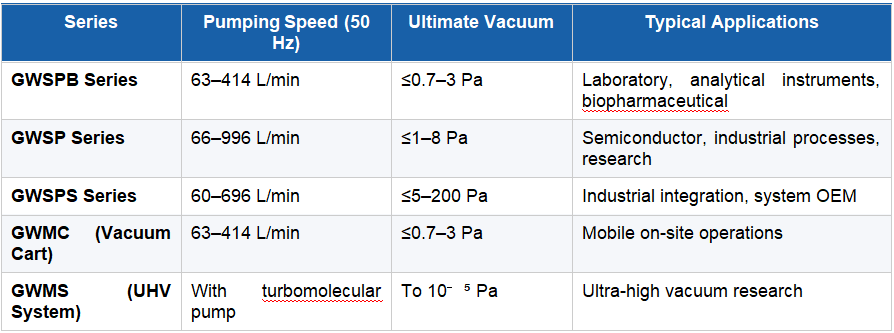
All Geowell products are certified to CE, RoHS, and EAC international standards, backed by 100+ patents, and deployed at over 100,000 installations across 40+ countries and regions.
7. Frequently Asked Questions
Q: Scroll pump vs. diaphragm pump — which should I choose?
Two factors determine the answer. First, ultimate vacuum: diaphragm pumps typically reach only tens of Pa, while scroll pumps reach 0.7 Pa — a substantial difference. Second, usage pattern: scroll pumps support continuous operation and frequent start/stop cycles with lower noise, making them suitable for precision labs and industrial processes. Diaphragm pumps are simpler and less expensive, appropriate for auxiliary equipment where high vacuum is not needed. For mass spectrometry or any application backing a high-vacuum system, an oil-free scroll pump is the industry standard.
Q: When should I choose a claw pump over a scroll pump?
The primary decision variable is pumping speed. If you need to rapidly evacuate a large chamber (>500 L) or your process demands very high volumetric throughput, claw pumps have a clear advantage. If noise is a concern (e.g. lab environments) or if cleanliness and low maintenance are priorities, scroll pumps are generally the better choice. Both types operate in a similar ultimate vacuum range — so pumping speed, not vacuum depth, is the main differentiator.
Q: Can oil-free vacuum pumps handle corrosive gases?
Yes, but the pump must be specified for corrosive duty. For diaphragm pumps, PTFE or other chemically resistant diaphragm materials are available. For scroll pumps, confirm that the tip seal material and pump body are compatible with your specific gas. Geowell offers corrosive-gas configurations — contact our applications team with your process gas data for a proper recommendation.
Q: Are oil-free vacuum pumps always more expensive than oil-sealed pumps?
Not necessarily. Entry-level diaphragm pumps are typically less expensive than comparable oil-sealed rotary vane pumps. Oil-free scroll pumps carry a higher initial purchase price, but their total cost of ownership (TCO) is usually lower over the equipment lifetime: no oil changes, no oil mist filters, no waste oil disposal, and no process losses from contamination. Across a multi-year service horizon, scroll pumps are frequently the more economical choice.
Q: What is the difference between the Geowell GWSPB and GWSP series?
The GWSPB series uses a single-stage scroll design — more compact body, ultimate vacuum down to 0.7 Pa. Recommended when you need the best achievable vacuum depth and maximum cleanliness. The GWSP series uses a two-stage scroll (dual-head) configuration that delivers higher pumping speeds — better suited for processes requiring higher volumetric flow rates. For precise model selection, share your process operating pressure range, chamber volume, and gas type with our technical team.
8. Summary: Match the Right Type to the Right Application
The differences between oil-free pump types are not quality rankings — they reflect fundamentally different design priorities suited to different applications. Selecting the right pump means accurately matching your process requirements (vacuum depth, pumping speed, gas cleanliness, noise tolerance, maintenance resources) to each type’s inherent strengths.
If you have already defined your ultimate vacuum requirement and gas cleanliness standard, the oil-free scroll vacuum pump covers the widest range of applications. If you still have questions, bring your specific process parameters to our team — Geowell’s application engineers provide one-on-one selection support from initial specification through to commissioning.
GEOWELL VACUUM CO., LTD.
Tel: +86-24-83685362 | Email: service@geowellscroll.com