
An oil-free scroll vacuum pump uses two precision-machined spiral-shaped scrolls — one stationary, one orbiting — to draw gas in, compress it, and discharge it without any lubricating oil in the gas flow path. Sealing is achieved through precision tip seals and close geometric tolerances between the scroll wraps, not oil films.
That answer is technically correct, but it raises an obvious follow-up: if oil is so central to sealing in conventional vacuum pumps, how can a scroll pump work reliably without it? The short answer is that oil-free scroll pumps replace the sealing function of oil with two complementary engineering solutions — tip seals and precision machining. Once you understand those two elements, everything else about scroll pump performance follows logically.
Geowell has designed and manufactured oil-free scroll vacuum pumps since 2002. This guide walks through the mechanism step by step: from basic vacuum principles to the exact geometry that makes oil-free operation possible, and what that means for real-world performance.
1. What a Vacuum Pump Actually Does
Before getting into scroll-specific mechanics, it helps to be clear about what any vacuum pump is doing at a fundamental level.
A vacuum pump removes gas molecules from a sealed chamber, reducing the pressure inside that chamber below atmospheric pressure. Simple enough in concept — but achieving it reliably requires solving two engineering problems simultaneously:
- Intake: drawing gas from the chamber into the pump without backflow;
- Discharge: compressing and expelling that gas out of the pump, again without backflow.
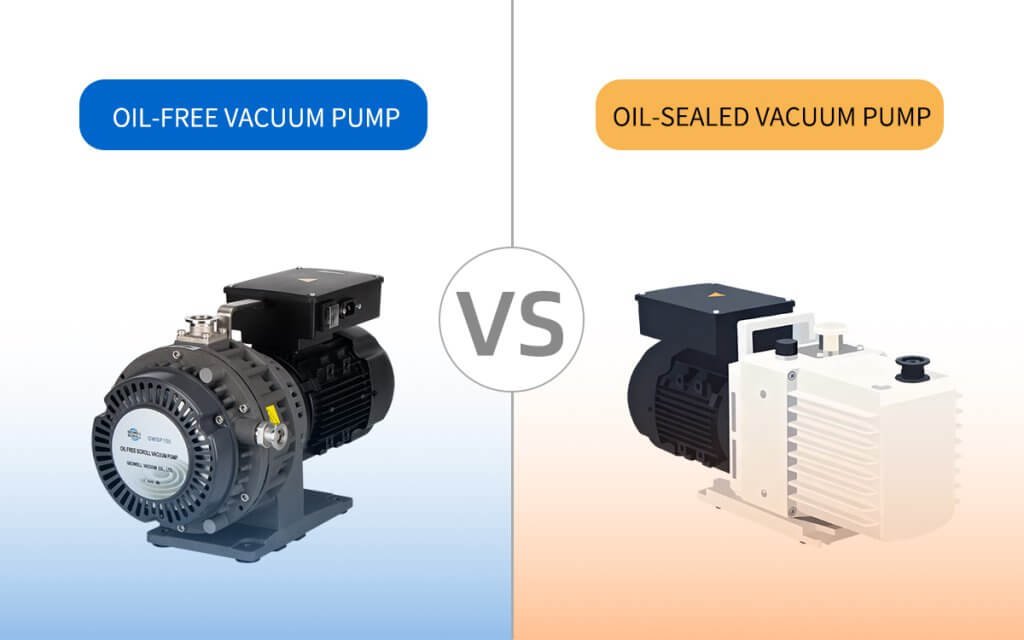
Oil-sealed rotary vane pumps solve both problems by flooding metal-to-metal contact surfaces with lubricating oil. The oil film fills microscopic gaps, preventing gas from leaking back through the pump. The trade-off: that oil inevitably enters the gas stream, either as droplets or vapor.
Oil-free scroll pumps solve the same problems differently: through precise mechanical geometry. The scroll geometry itself controls gas flow direction. Tip seals and machining tolerances prevent cross-leakage between compression chambers. No oil enters the gas path at any point.
2. Scroll Pump Core Structure: Orbiting and Fixed Scrolls
The pumping mechanism of an oil-free scroll vacuum pump consists of two interlocking spiral-shaped components:
- Fixed scroll: mounted rigidly in the pump housing; does not move.
- Orbiting scroll: driven by an eccentric mainshaft; executes a planar orbital motion around the fixed scroll’s central axis.
Both scrolls have identical involute spiral wraps machined into their faces. When assembled, the two spiral wraps mesh together, offset by 180°. The space between the meshing wraps naturally forms a series of enclosed crescent-shaped gas pockets.
These pockets have two key geometric properties that drive the entire pumping action:
- Their volume is not fixed — it changes continuously as the orbiting scroll moves.
- Their position migrates inward — from the outer edge of the scroll toward the center — as the orbiting scroll completes each orbit.
Isolation between adjacent pockets is maintained by tip seals on the top edge of each scroll wrap, and by the tight radial clearance between the wrap sidewalls — not by any fluid sealant.
Key point: The two scrolls never make contact during operation. The orbiting scroll maintains a precise clearance from the fixed scroll throughout its travel. This non-contact design is what makes oil-free operation mechanically possible.
3. How the Pumping Cycle Works: Suction, Compression, Exhaust
The orbiting scroll is driven by an electric motor via an eccentric shaft. It does not rotate about its own axis — instead, it orbits the central axis of the fixed scroll while maintaining a fixed angular orientation. Think of a coin rolling around a second coin without spinning: that is the motion of the orbiting scroll.
This orbital motion drives the crescent-shaped gas pockets inward continuously, shrinking their volume as they travel. Three phases of the pumping cycle run simultaneously in different zones of the scroll assembly:
Phase 1 — Suction
The outermost pockets are open to the pump inlet. As the orbiting scroll moves, these outer pockets expand slightly, creating a pressure differential that draws gas in from the vacuum chamber. The orbiting scroll’s next movement seals the pocket off from the inlet, trapping the gas inside.
Unlike a reciprocating piston pump — which takes in one charge of gas per revolution — the scroll inlet is effectively continuous. The outer pockets are constantly capturing new gas as the orbiting scroll turns.
Phase 2 — Compression
Once sealed, each pocket migrates inward. Because the scroll geometry dictates a progressively smaller pocket volume as you move toward the center, the trapped gas is compressed continuously as the pocket travels. Pressure rises steadily; there is no sudden impact event.
This gradual, impact-free compression is the direct mechanical reason why scroll pumps run quietly and with low vibration. There are no reciprocating parts, no valves slamming open and shut, and no pressure spikes.
Phase 3 — Exhaust
When a pocket reaches the center of the scroll assembly, it connects with the exhaust port and discharges its compressed gas into the exhaust line. The gas passes through an exhaust silencer before being released to atmosphere.
Scroll pumps have no inlet or exhaust valves — flow direction is controlled entirely by the scroll geometry. Fewer moving parts means fewer wear points and fewer noise sources.
Summary: Suction at the outer edge, compression in transit, discharge at the center — all three phases run simultaneously in different zones. The result is continuous, pulse-free gas flow, which is why scroll pumps are inherently quieter than piston or rotary vane pumps.
4. How Oil-Free Sealing Works: Tip Seals and Machining Precision
The obvious question at this point is: what actually seals the gas pockets from each other? If gas can leak between adjacent pockets, the pressure differential needed for pumping collapses.
Two complementary mechanisms handle this — one at the tip of each scroll wrap, one at the sidewalls.
Tip Seals
A purpose-designed tip seal strip is installed along the top edge of each scroll wrap. As the orbiting scroll moves, these tip seals maintain light contact with the opposing scroll’s flat face, creating a continuous end-face seal across the scroll wrap profile.
Tip seals are the primary wear component in an oil-free scroll pump — they are what you replace during routine maintenance. Under normal operating conditions, Geowell pumps run 16,000+ hours between tip seal replacements, equivalent to approximately two years of continuous operation. This predictable maintenance interval is one of the reasons scroll pump total cost of ownership is lower than oil-sealed alternatives.
Radial Clearance and Machining Precision
Tip seals handle end-face sealing. The sidewall-to-sidewall (radial) gap between adjacent scroll wraps is controlled entirely by machining tolerances. The gap must be small enough to restrict gas leakage to acceptable levels, but it cannot be zero — contact would cause wear.
Holding this tolerance consistently across the full spiral profile of both scrolls, while maintaining it over tens of thousands of hours of operation, is the central manufacturing challenge of oil-free scroll pump production. It is also the primary reason why scroll pump quality varies substantially between manufacturers. Geowell’s ability to sustain an ultimate pressure of 0.7 Pa across its product line reflects 20+ years of refinement in scroll machining and assembly processes.
Together, tip seals and radial precision replace everything that lubricating oil does in a conventional pump — without any fluid entering the gas path.
5. Performance Characteristics That Follow from the Design
The operating properties of oil-free scroll pumps are not marketing claims — they are direct consequences of the mechanical design described above.
Oil-Free Gas Stream
Because the pumping mechanism contains no lubrication in the gas flow path, the pumped gas exits the system with zero oil contamination. This is a structural guarantee, not a filter-dependent one. A downstream oil filter can reduce oil carryover from a rotary vane pump; it cannot eliminate it. An oil-free scroll pump does not generate oil contamination to begin with.
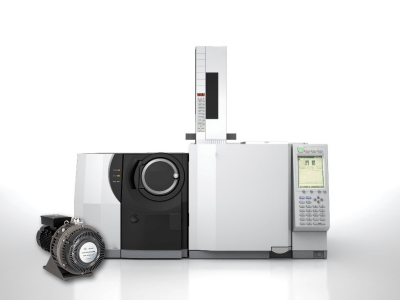
For applications where even trace oil vapor is unacceptable — mass spectrometry, semiconductor process chambers, pharmaceutical sterile manufacturing — this distinction is the primary selection criterion.
Low Noise and Vibration
The orbiting scroll’s planar orbital motion is inherently smooth. There are no reciprocating components, no valves, and no impact events in the compression cycle. The two scrolls maintain non-contact throughout operation. Geowell’s GWSPB series operates at ≤50 dB(A) — a level achievable not through external acoustic treatment, but through the nature of the scroll mechanism itself.
Simplified Maintenance
Eliminating lubrication oil from the gas path eliminates the entire oil system maintenance routine: no oil changes, no oil level checks, no oil mist filters, no oil disposal. Routine service consists of periodic tip seal and O-ring replacement on a scheduled interval. Downtime is short, the work is straightforward, and operators can perform it without specialized training.
Unrestricted Start-Stop
Scroll pumps reach operating vacuum quickly from a cold start and support frequent start-stop cycling across the full pressure range from atmosphere to ultimate vacuum. There is no warm-up period, no oil temperature dependency, and no residual oil drainage concern. Laboratory users in particular benefit from the ability to start and stop the pump as casually as switching on bench equipment.
6. Oil-Free Scroll Pumps vs. Other Vacuum Pump Types
The following comparison places oil-free scroll pump performance in context against the other pump types commonly used in similar applications:
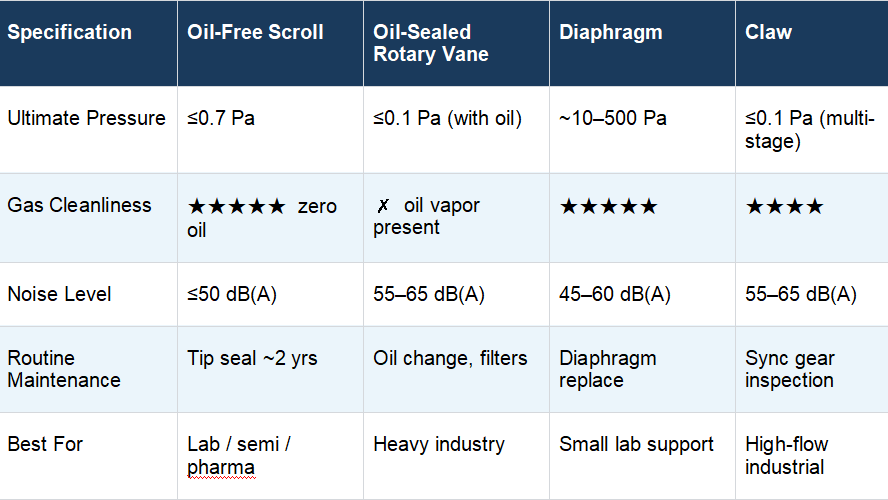
One comparison worth expanding: diaphragm pumps also deliver oil-free gas, but their achievable ultimate pressure is typically 10–500 Pa — two to three orders of magnitude worse than a scroll pump. If your process requires pressures below 10 Pa, a diaphragm pump is not in contention regardless of its other attributes.
7. Geowell Oil-Free Scroll Vacuum Pumps
Geowell (Shenyang Geowell Applied Technology Co., Ltd.) has focused exclusively on oil-free scroll vacuum pumps since 2002. The company’s technical development over that period has concentrated on the three factors that most directly determine scroll pump performance: scroll machining precision, tip seal material formulation, and gas ballast system design.
Current specifications:
- Ultimate pressure: down to 0.7 Pa
- Noise level: ≤50 dB(A) across the full range
- Tip seal service interval: ≥16,000 hours (~2 years)
- Gas ballast valve: standard on all models, for water vapor and condensable gas applications
- Inlet/exhaust connections: KF flange (standard)
- Model range: GWSP series through GWSPB series — laboratory to mid-scale industrial
- Certifications: CE, RoHS, EAC; 100+ patents
- Installed base: 100,000+ users in 40+ countries
Frequently Asked Questions
What is the difference between an oil-free scroll pump and an oil-sealed rotary vane pump?
The fundamental difference is how sealing is achieved. A rotary vane pump floods metal-to-metal contact surfaces with lubricating oil; that oil inevitably carries over into the pumped gas as vapor or fine droplets. An oil-free scroll pump seals its compression chambers through tip seals and precision-machined clearances — no oil enters the gas path at any point. The consequence is cleaner gas output, lower maintenance burden (no oil system), and the ability to start and stop freely. Trade-off: oil-sealed pumps can reach lower ultimate pressures when the oil film contributes to sealing.
What is orbital motion, and why does it matter for scroll pump design?
In a standard rotary mechanism, a component spins about its own axis. In orbital motion, the orbiting scroll moves in a circular path around the fixed scroll’s central axis without rotating about its own center — its angular orientation stays fixed throughout the orbit. This is what causes the crescent-shaped gas pockets to migrate continuously inward while changing volume. The absence of self-rotation is also why the motion produces no reciprocating forces, making scroll pumps inherently smoother and quieter than piston-type pumps.
How often do tip seals need to be replaced, and can users do it themselves?
Under normal operating conditions (dry, clean gas; within rated temperature range), Geowell pump tip seals last 16,000 hours or more — approximately two years of continuous operation. If pumping water vapor, solvent fumes, or other condensable gases, shorter inspection intervals are advisable. The replacement procedure is described in the product manual and does not require specialized tools or factory service. Geowell supplies dedicated maintenance tool kits (GWRK series) for each pump model to simplify the process.
What ultimate pressure can an oil-free scroll vacuum pump reach?
Commercial oil-free scroll pumps typically achieve 1–5 Pa ultimate pressure; high-performance models such as the Geowell GWSPB series reach 0.7 Pa. If your application requires pressures below 10⁻³ Pa (high vacuum or ultra-high vacuum), a scroll pump is used as a backing pump in combination with a turbomolecular pump — the scroll pump handles the rough-vacuum stage; the turbo pump extends performance into the high-vacuum range.
What is the gas ballast valve and when should it be used?
The gas ballast valve (sometimes called an air flush valve) is a small admittance valve on the exhaust side of the pump. When open, it introduces a controlled flow of dry air into the compression zone, raising the partial pressure of non-condensable gas and preventing water vapor or solvent vapor from condensing inside the pump. Use the gas ballast when pumping any gas stream that contains water vapor, solvent fumes, or other condensable components. When pumping dry, clean gases, closing the gas ballast will improve ultimate pressure. Geowell includes a gas ballast valve as standard on all pump models.
Is an oil-free scroll pump suitable for corrosive gases?
Standard scroll pumps are designed for clean, dry, non-corrosive gas streams. For corrosive applications, consult the pump manufacturer — material upgrades (corrosion-resistant scroll coatings, chemically compatible O-rings and tip seal compounds) may be available. Geowell’s engineering team can advise on suitable configurations for specific gas compositions.
Summary
An oil-free scroll vacuum pump replaces lubricating oil with two precision engineering solutions: purpose-designed tip seals that create end-face seals across the scroll wraps, and tight machined clearances that control radial leakage between compression chambers. The orbiting scroll’s continuous, impact-free motion drives gas from the periphery to the center in a smooth, pulse-free cycle. The result is a pump that delivers clean gas output, low noise, long service intervals, and flexible operation — all as direct consequences of the mechanism, not as add-on features.
If you are evaluating scroll pumps for a specific application, the most useful inputs are: target operating pressure range, chamber volume, gas composition (dry/wet/corrosive), and duty cycle. With those parameters, Geowell’s technical team can identify the appropriate model and configuration.
GEOWELL VACUUM CO., LTD. | Shenyang, China
Tel: +86-24-83685362 Email: service@geowellscroll.com