
Dry vacuum pumps are widely used in semiconductors, pharma, analytical instruments, food packaging, and vacuum coating. Learn key applications and why oil-free scroll pumps stand out.
If you’ve been researching vacuum pump selection recently, you’ve almost certainly come across the term dry vacuum pump — sometimes called an oil-free vacuum pump. It works differently from traditional oil-sealed pumps and liquid ring pumps, but most resources don’t do a great job explaining where the differences actually matter.
That’s what this guide is for: what dry vacuum pumps can do, which industries rely on them, and how to think about your own application. If you’re specifically interested in oil-free scroll vacuum pumps — one particular type within the dry pump family — the second half of this article focuses on exactly that.
What Exactly Is a Dry Vacuum Pump?
1.1 The Basic Definition
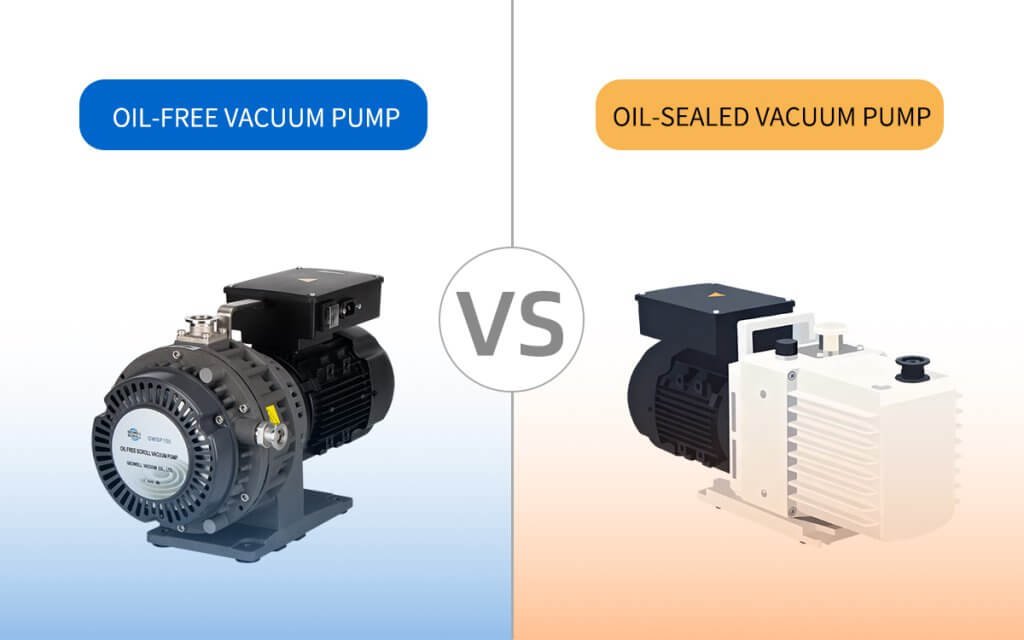
The defining characteristic of a dry vacuum pump is simple: no oil is involved in the pumping chamber. This sets it apart from rotary vane pumps, which rely on pump oil to seal the gap between the vane and the chamber wall. Because there’s no oil in the gas path, the vacuum produced is genuinely clean — free from oil vapor contamination.
Dry vacuum pump is actually a family of technologies rather than a single design. It includes screw pumps, claw pumps, Roots pumps, and scroll pumps, among others. They share the same oil-free principle but differ in noise levels, achievable vacuum depth, flow capacity, and maintenance requirements.
1.2 Dry Pump vs. Oil-Sealed Pump: What’s the Difference?
A quick comparison to make the distinction concrete:
Oil-sealed pump: Relies on pump oil for sealing. Can reach deep vacuum levels, but carries the risk of oil backstreaming into the process, and requires regular oil changes plus disposal of used oil.
Dry vacuum pump: No oil in the gas path. Produces clean vacuum, lower ongoing maintenance, and is well suited for contamination-sensitive processes and laboratory environments.
That distinction drives everything about where dry pumps get used: anywhere oil contamination is simply not acceptable.
Key Application Areas for Dry Vacuum Pumps
Dry vacuum pumps show up across a surprisingly wide range of industries. Here’s a breakdown of the most common ones.
2.1 Semiconductor and Electronics Manufacturing
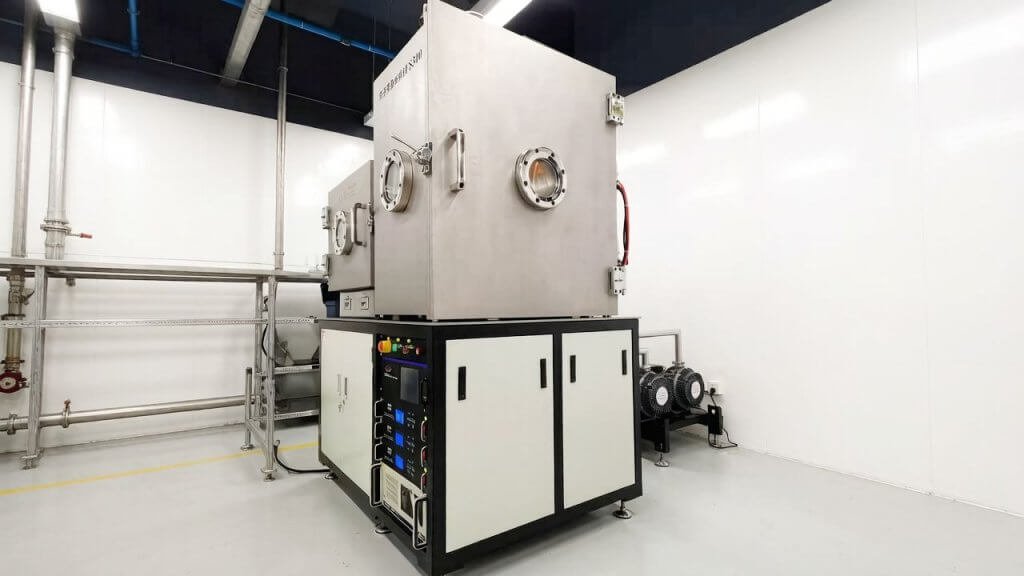
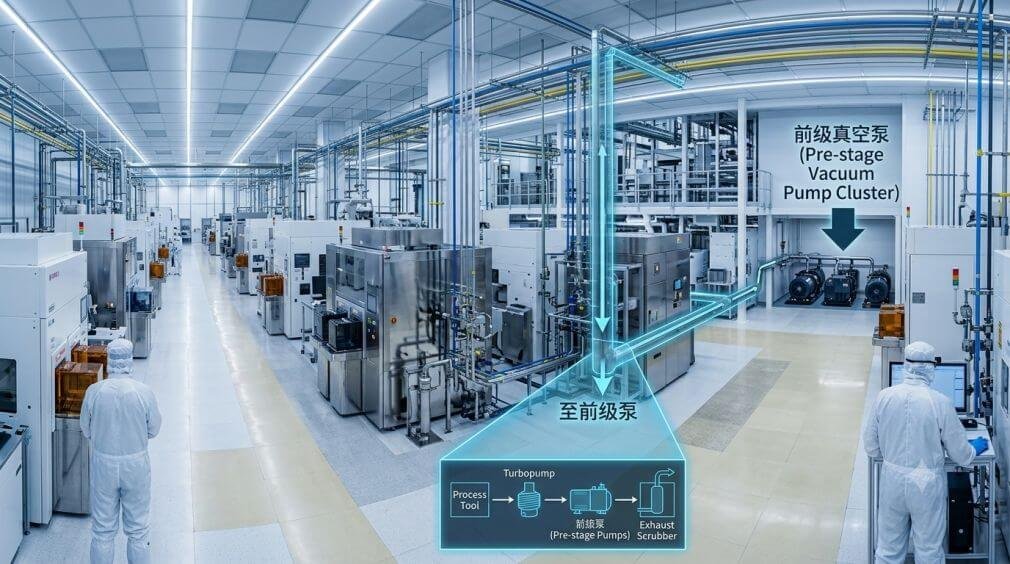
This is arguably the most demanding sector for dry vacuum pumps — and one of the largest markets. Critical chip fabrication steps such as chemical vapor deposition (CVD), physical vapor deposition (PVD), etching, and ion implantation all require high or ultra-high vacuum environments.
Why can’t oil pumps be used here? Even trace amounts of oil vapor entering the process chamber can contaminate wafer surfaces and drive yield losses that cost hundreds of thousands of dollars per incident. Dry pumps eliminate that risk at the source.
Semiconductor fabs also demand extremely high pump reliability — unplanned downtime is extraordinarily expensive — making the long service intervals and stable operation of dry pumps particularly valuable.
2.2 Analytical Instruments: Mass Spectrometers and Gas Chromatographs
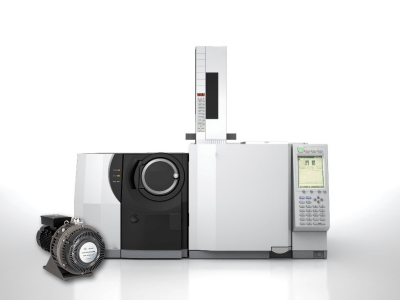
Mass spectrometers require high vacuum in both the ion source and the analysis chamber to function correctly. If an oil pump backstreams into the ion source, the contamination directly compromises measurement accuracy and triggers expensive cleaning cycles.
Using dry vacuum pumps as the roughing pump stage in mass spectrometry is now standard practice. The same logic applies to GC-MS systems: the reliability of analytical results is directly tied to how clean the vacuum system is.
These applications typically don’t require high flow rates, but the tolerance for any oil contamination is essentially zero — which is exactly the scenario where compact oil-free scroll vacuum pumps excel.
2.3 Pharmaceutical and Life Sciences
The pharmaceutical industry’s cleaning standards are well established — GMP (Good Manufacturing Practice) frameworks require that contamination risks be controlled at every step of production.
Typical dry pump applications in pharma include:
- Vacuum drying: Removing moisture and solvents from active pharmaceutical ingredients (APIs) or formulations. Oil pumps create a hazard when solvent vapors contact pump oil; dry pumps avoid this entirely.
- Filtration and distillation: Vacuum distillation and reduced-pressure processes require stable, contaminant-free vacuum environments.
- Freeze dryer (lyophilizer) backing: Lyophilization runs involve long operating cycles with variable loads — the durability and low-maintenance character of dry pumps is a strong fit.
Biotech applications — cell culture media preparation, sterile filtration, bioreactor support — increasingly specify dry pumps as labs upgrade away from oil-sealed alternatives.
2.4 Vacuum Coating and Surface Treatment
Physical vapor deposition (PVD), sputtering, and magnetron sputtering are widely used for optical coatings, decorative finishes, and functional thin films. Oil contamination inside the coating chamber degrades film adhesion — sometimes catastrophically.
Dry vacuum pumps typically serve as the roughing or backing pump in coating equipment, working alongside turbomolecular pumps to reach the required process vacuum. This combination pump architecture is standard in high-end coating systems.
2.5 Research Laboratories and Universities
University physics labs, chemistry departments, and materials research centers share common characteristics: diverse equipment, varied experimental requirements, and researchers who want reliable vacuum without spending time on pump maintenance.
Oil-free scroll vacuum pumps are particularly popular in research settings because of their compact footprint, low noise (typically 50-60 dB, considerably quieter than rotary vane pumps), and zero oil-change maintenance. A pump that sits on a bench without making noise, producing fumes, or requiring attention lets researchers focus on their actual work.
2.6 Lithium Battery and Photovoltaic Manufacturing
Both industries represent significant growth areas for dry vacuum pump demand. Battery cell assembly, electrolyte filling, and formation cycling all require vacuum environments to remove air bubbles and exclude moisture. Solar cell thin-film deposition processes depend equally on clean vacuum.
These production lines run continuously at high automation levels, with reliability and cleanliness requirements comparable to semiconductor manufacturing — making dry pumps the natural choice.
Oil-Free Scroll Vacuum Pumps: The Precision Specialist of the Dry Pump Family
With the broad application landscape covered, it’s worth focusing more specifically on oil-free scroll vacuum pumps — a distinctive member of the dry pump family with a different working principle and a particular set of strengths.
3.1 How a Scroll Vacuum Pump Works (The Short Version)
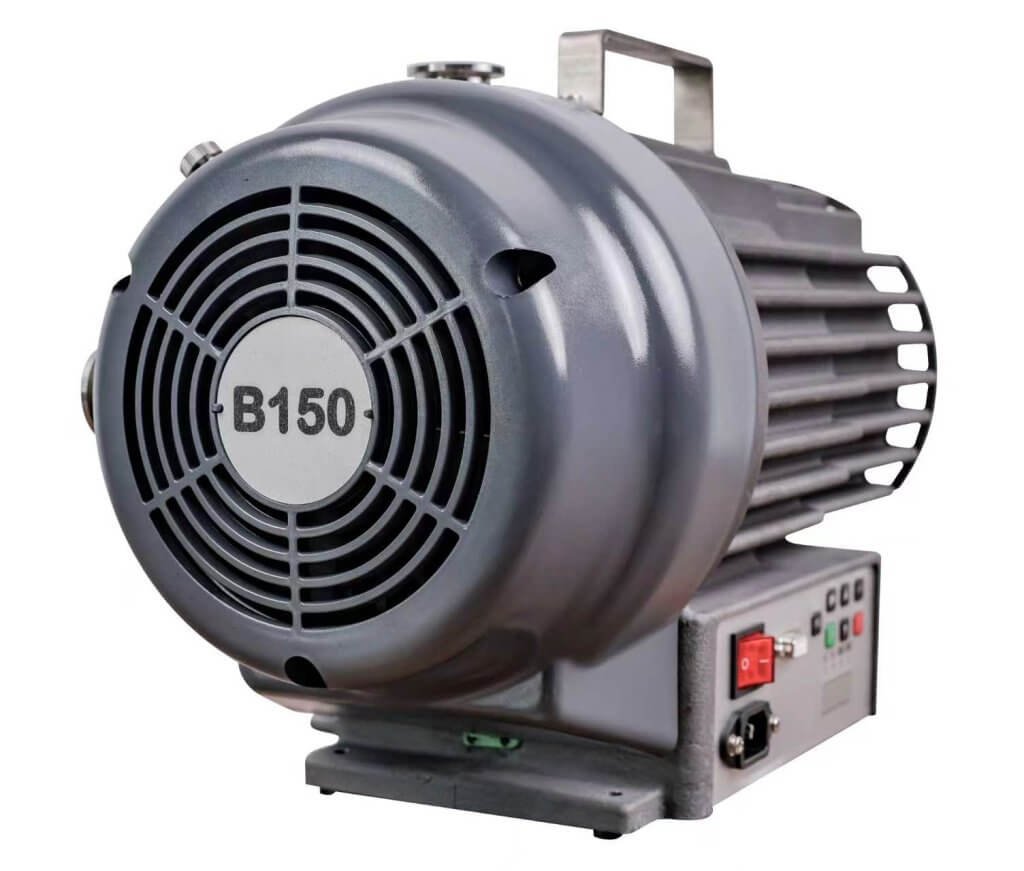
A scroll vacuum pump uses two spiral-shaped scroll elements: one fixed (the stationary scroll) and one that orbits around it (the orbiting scroll). Gas trapped in the pockets between the scrolls is progressively compressed toward the center and discharged.
Because there’s no reciprocating piston, scroll pumps run very smoothly — low vibration, low noise. The absence of oil in the pumping chamber means the discharged gas is clean.
3.2 Where Oil-Free Scroll Pumps Are Particularly Well Suited
- Applications requiring extremely clean vacuum: mass spectrometry, chromatography, semiconductor small-flow backing
- Laboratory environments or anywhere noise levels matter
- Long-running applications with limited maintenance resources
- Corrosive or reactive gas handling (with appropriately configured corrosion-resistant variants)
- Processes requiring continuous operation exceeding 10,000 hours
Compared to other dry pump types, scroll pumps have a narrower flow range — they’re not the right choice for very high-volume applications like large industrial coating furnaces. Their ultimate vacuum is also limited to roughly 1-10 Pa without a backing turbomolecular pump. But within their operating range, the combination of gas cleanliness and low maintenance is hard to match.
Questions Worth Answering Before You Select a Dry Pump
Dry pumps are genuinely useful — but selecting the wrong type for a given application is a real risk. Here are the key dimensions to think through before making a decision.
4.1 Does Your Application Actually Require Oil-Free Vacuum?
Not every vacuum application is sensitive to oil contamination. Simple workholding, vacuum chucking, and negative-pressure conveying can often be handled just as well by conventional oil pumps at lower upfront cost and with higher ultimate vacuum capability. The premium for dry pumps is justified when your process has a clear requirement for clean, oil-free gas.
4.2 What Vacuum Level and Flow Rate Do You Need?
Oil-free scroll vacuum pumps typically achieve ultimate pressures of 1-10 Pa, with pumping speeds ranging from a few tens to a few hundred liters per minute. If your application requires deeper vacuum (for example, 10^-5 Pa range), a scroll pump can serve as the backing stage for a turbomolecular pump. Very high flow rate requirements — large industrial coating chambers, for instance — may point toward screw-type dry pumps or parallel pump arrays instead.
4.3 Process Gas Compatibility
Are you pumping corrosive gases containing halogens or acid species? Particulate-laden gas streams? These process conditions impose specific material requirements on the pump. Confirm whether the supplier offers purpose-built corrosion-resistant or particle-tolerant variants — and communicate your gas composition upfront rather than after installation.
4.4 Total Cost of Ownership, Not Just Purchase Price
Dry pumps carry a higher initial cost than rotary vane pumps. But the full accounting looks different: no oil purchases, no oil disposal costs, significantly less maintenance labor, and lower unplanned downtime. In high-value production environments — semiconductors, pharma, precision instrument manufacturing — the long-term total cost of ownership typically favors dry pumps clearly.
About GEOWELL Oil-Free Scroll Vacuum Pumps
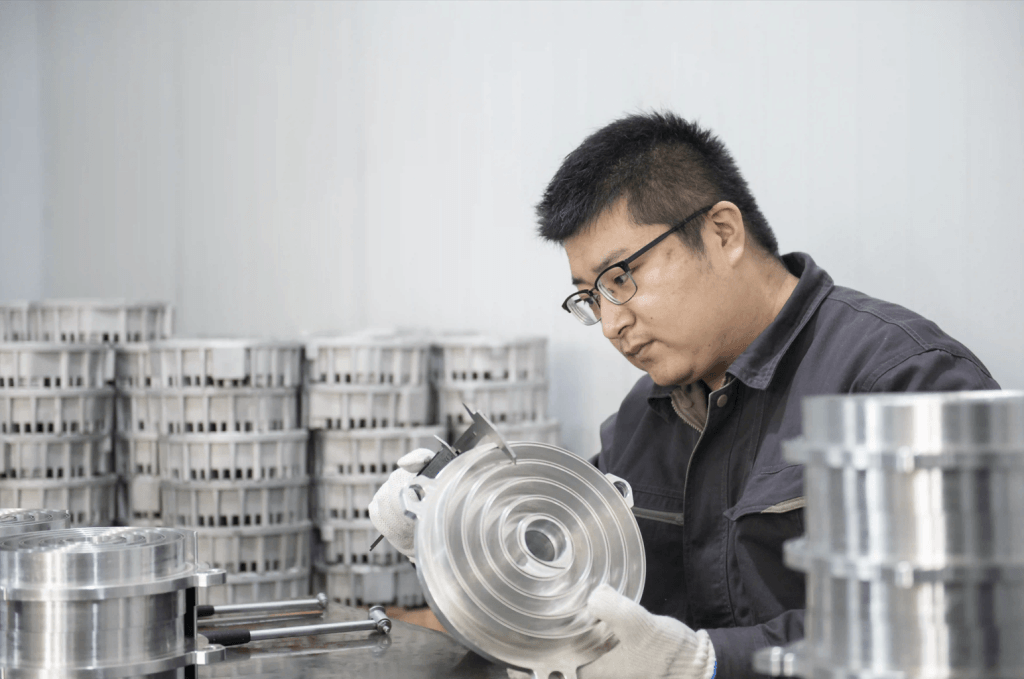
GEOWELL VACUUM CO., LTD. has specialized in the research, development, and manufacturing of oil-free scroll vacuum pumps and compressors since 2002. Products range from compact single-unit laboratory pumps to industrial multi-pump parallel configurations, with established application references in semiconductors, analytical instruments, pharmaceuticals, and scientific research.
| Core advantages: High gas cleanliness (zero oil contamination), quiet operation, extended service intervals, corrosion-resistant variants available, and technical selection support from application engineers. |
| Certifications: CE, RoHS, EAC, ISO 9001 — plus over 100 patents and proprietary technologies developed over more than two decades of focused R&D. |
If you’re working through a selection decision for a specific application, the GEOWELL engineering team can work through the vacuum level, flow rate, gas composition, and budget requirements with you — rather than just sending a spec sheet and leaving you to figure it out.
| Need Help Selecting the Right Vacuum Pump? Contact the GEOWELL engineering team for a free technical consultation. Website inquiry / Email your application parameters / Phone or online chat — all welcome. Website: https://www.geowellscroll.com | Email: sales@geowellscroll.com |
6. Frequently Asked Questions
Q: Are dry vacuum pumps and oil-free vacuum pumps the same thing?
Essentially yes, though the terminology is slightly different in emphasis. ‘Dry vacuum pump’ emphasizes that no liquid is present in the pumping chamber; ‘oil-free vacuum pump’ specifically emphasizes the absence of oil. In practice, the two terms are used interchangeably. Technically, the dry pump family includes liquid ring pumps that use water as a sealing medium, so ‘oil-free’ is the more precise descriptor for contamination-sensitive applications.
Q: Can oil-free scroll vacuum pumps handle corrosive gases directly?
Standard configurations are not optimized for corrosive media — the internal seals and materials aren’t selected for that service. However, GEOWELL and other specialist manufacturers offer corrosion-resistant variants with appropriate coatings and seal materials for applications involving halogens, acid gases, and similar aggressive species. Always communicate gas composition before selecting a pump.
Q: Dry pumps cost more upfront — how do you make the case to procurement?
The argument is built on total cost of ownership rather than purchase price alone. An oil-sealed pump requires oil changes every few months: oil cost, disposal fees, and maintenance labor add up significantly over time. A dry scroll pump typically needs only a seal inspection every one to two years. Lower unplanned downtime adds further savings in high-value production environments. The numbers usually favor dry pumps clearly over a three- to five-year horizon.
Q: What ultimate vacuum can an oil-free scroll pump reach?
Standard oil-free scroll vacuum pumps achieve ultimate pressures in the range of 1 to 10 Pa (approximately 0.01 to 0.1 mbar). This covers the majority of laboratory and analytical instrument applications. For applications requiring deeper vacuum — high-energy physics experiments, electron microscopy, surface science — a scroll pump works well as the roughing stage backing a turbomolecular pump.
A Final Thought
Dry vacuum pumps cover a wide range of applications — but different dry pump types are suited to different conditions. An oil-free scroll pump performs exceptionally well in clean, quiet, low-maintenance scenarios; it’s not the right answer for every situation. Understanding your actual process requirements is what gets you to the right choice.
Hopefully this guide has given you a useful framework for thinking about dry pump selection. If you have a specific technical question, reaching out to an application engineer directly will usually get you further than any article can — a ten-minute conversation covers a lot of ground.